
A basic explanation on how price mechanism affects everything around us
A core phenomenon in economics, the price system is as crucial to markets as overthinking is to me. One of the fundamental components in Adam Smith’s renowned The Invisible Hand, price system is just what it appears to be, the mechanism of assigning values to goods and services and thereby driving economic decisions and resource allocation. It is the heartbeat of market economies, orchestrating the complex interplay of supply and demand. But how do prices drive the economy? In this article, we delve into the two-pronged function of prices.
Prices reveal information

A basic truth incorporated into any price system is the fact that stores and consumers do not have to buy or sell at a given price – they can always opt out. If I were to step into a designer store and be willing to pay only half the cost for something (sounds ridiculous, yes), nobody would force the store to drop the price, or force me to raise mine. The sale simply does not occur.
So, even when prices often seem to be very high, one can always choose not to pay that amount. This is how prices reveal valuable, or rather, priceless information. Information about wants, needs and costs.
In a free market, people only buy things if they believe the value is equal to or higher than the price. Likewise, they only sell things if they believe the value is less than the price. For example, I might choose to buy a commodity because I think it’s worth the price. The worth here refers to the value of the product, which to me is equal to or higher than the price.
This free choice produces information about my personal preferences and when billions of us make choices, market prices aggregate the preferences of us all.
Prices act as a signal

Let us tune into a language I quite fairly understand, discount and sale. If I get a notification from a clothing company, let’s say Zara, announcing a sale on its app, what does that tell me? A, it tells me that my savings are going to suffer. B, it signals changes in supply and demand dynamics within the market. When Zara announces a sale, it’s often in response to various factors influencing the market. For instance, if there’s an excess supply of certain clothing items due to overproduction or seasonal changes, Zara may opt to reduce prices to clear out surplus inventory. Conversely, if there’s a surge in demand for products, they might increase prices to capitalise on consumer interest.
This fluctuation in prices serves as a crucial signal to both consumers and producers. For consumers, it indicates an opportunity to purchase goods at a discounted rate, influencing their buying behaviour. For producers, it informs them about changing market conditions and prompts decisions regarding production and pricing strategies.
In essence, price fluctuations convey valuable information about the state of the market, helping to allocate resources efficiently and facilitating adjustments in supply and demand. This signaling function of prices is essential for maintaining market equilibrium and ensuring that resources are utilised optimally.
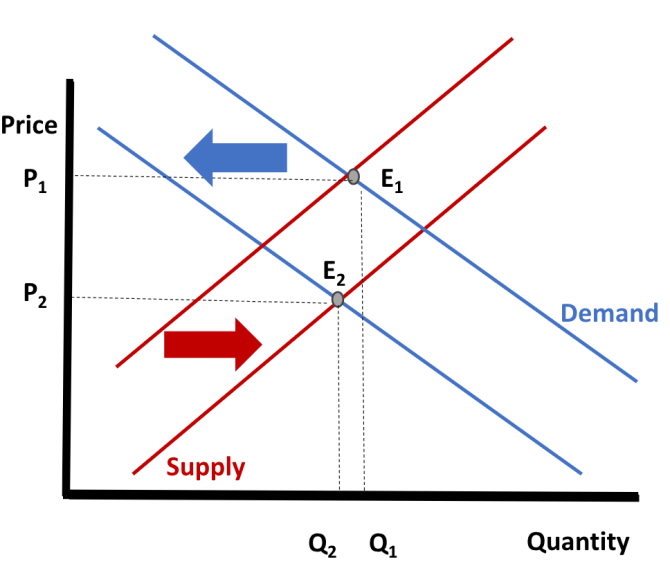
Figure above illustrates a simplified Demand – Supply curve, reflecting how prices work to achieve a new market equilibrium in the event of a sale, assuming a free market state.
In summary, prices are fundamental to markets, guiding both consumers and businesses in their decisions. They do this in two main ways: by revealing information about what people want and what things cost, and by sending signals about changes in supply and demand.
These price signals help keep the economy balanced, ensuring that resources are used efficiently and that everyone’s needs are met. So, next time you see a price tag or a sale sign, remember that it’s more than just a number – it’s a crucial part of how our economy works.

 Crossroads Chronicles
Leave a reply to avisingh2260 Cancel reply