
How governments intervene when externalities arise and free markets fail to account for social welfare loss
Imagine this: I plant rows of jasmine in my garden, and you live next door. Every morning, you wake up to the sweet fragrance of the flowers wafting through your window. You did not ask for it, and I did not charge you for it. But your mornings just got a little better. That’s an externality.
An externality is an effect of an action that affects others without their consent or any compensation. If my actions impact you (positively or negatively), and neither of us can charge or be charged for it, that’s an externality.
All about Negative Externalities

A negative externality occurs when an action imposes unintended costs on others; costs the responsible party does not bear. For example, when a factory emits pollution into a river, people downstream bear the cost, not the factory. Or take cigarettes as an example: smoking might bring enjoyment to the smoker, but it affects everyone nearby. Does the smoker bear the costs of health damage caused by his actions? No! The individual only considers the private costs – not the social costs that others bear, like poor health or even environmental harm.
Let’s look at this visually. In a free market, the quantity consumed (at point QP) is where Marginal Private Cost (MPC) meets Marginal Benefit (MB). But this ignores the hidden costs – like second-hand smoke or public health expenses. When we account for these, we get the Marginal Social Cost (MSC) curve, which lies above the MPC. The socially optimal outcome is at a lower quantity (Qs) and a higher price (Ps), where MSC meets MB. In a market with a negative production externality, the market equilibrium (Qp) is above the socially optimal level of production (Qs) because the producer only takes into account their own cost and not the negative impact on society. This leads to a deadweight loss (yellow triangle in the diagram) which represents the loss of social welfare due to the over-production of the good or service.
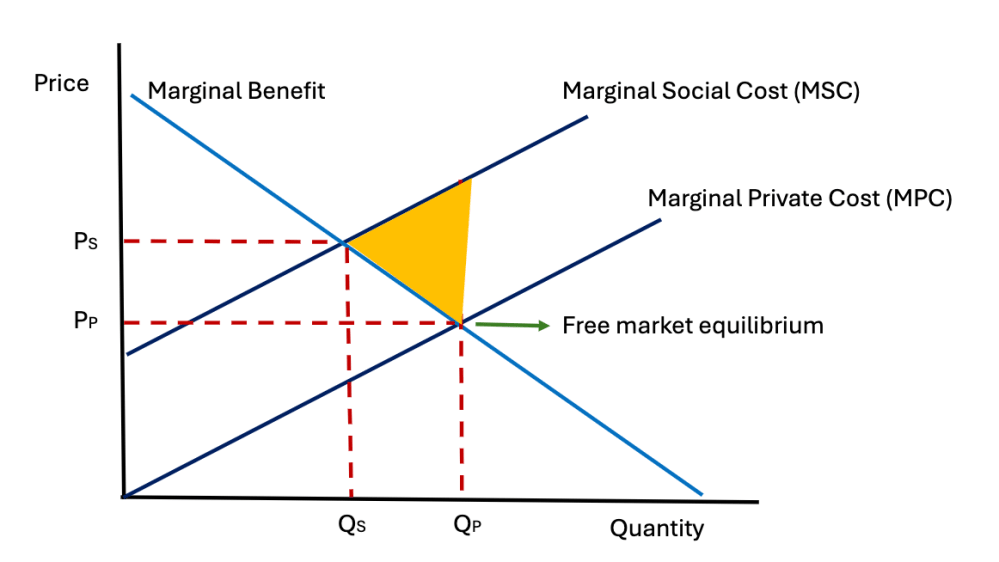
The graph illustrates a market with a negative production externality. We assume the marginal social benefit (MSB) is equal to the marginal private benefit (MPB), which is shown by the Marginal Benefit line.
The Fix
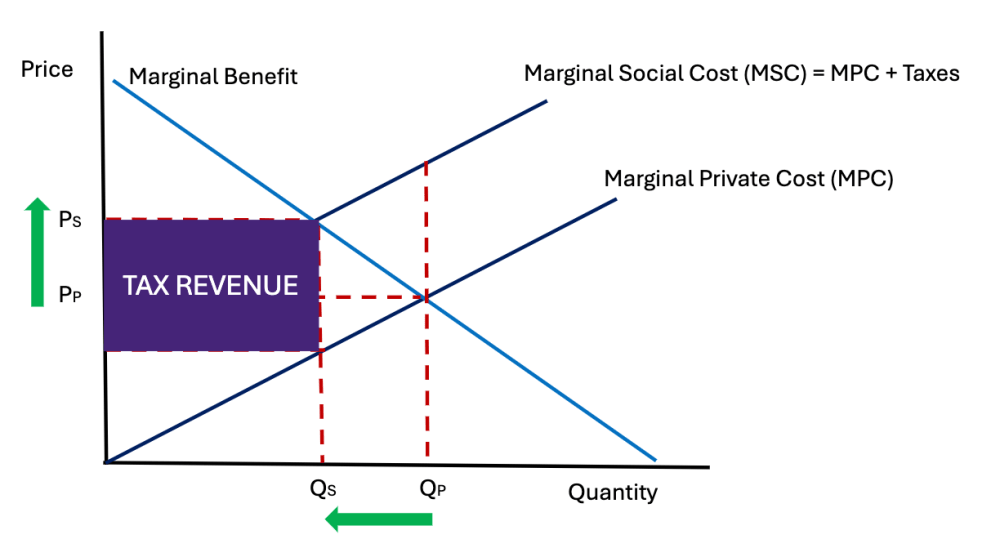
How is the welfare loss and overproduction fixed? This market failure is usually resolved with government intervention. Governments often intervene with taxes, a policy known as Pigouvian taxation. By imposing a tax equivalent to the external cost (the gap between Marginal Private Cost and Marginal Social Cost), they effectively shift the supply curve upward. This new, higher price discourages consumption and nudges the market toward the socially optimal quantity.
Visually, this intervention reduces the excessive consumption from QP to Qs and increases the price from PP to Ps. This tax not only generates revenue, but also internalises the externality, meaning it forces private decision-makers to consider the broader social costs of their actions.
In practice, this logic underpins cigarette taxes, carbon pricing, congestion charges, and more. The goal is to reveal the true cost of harmful behaviour and recalibrate incentives to reflect society’s best interest. It’s a way of using the market against its own failure.
All about Positive Externalities

A positive externality occurs when an individual’s or firm’s actions benefits others who are not a part of the transaction. Consider education: a well-educated person earns more and makes better decisions, but society also benefits from lower crime and higher productivity. Yet, because these broader benefits are not captured in the private decision-making, the market usually underprovides such goods.
In a free market, individuals make choices where Marginal Benefit (MB) equals Marginal Private Cost (MPC) – so the quantity provided is QS, which seems efficient at first glance. But this ignores the extra benefit to society. In a market with a positive production externality, the market equilibrium (Qs) is below the socially optimal level of production (Qp) because the producer only takes into account their own benefit and not the positive impact on society. This leads to a deadweight loss (yellow diagram in the diagram) which represents the loss of social welfare due to the under-production of the good or service.
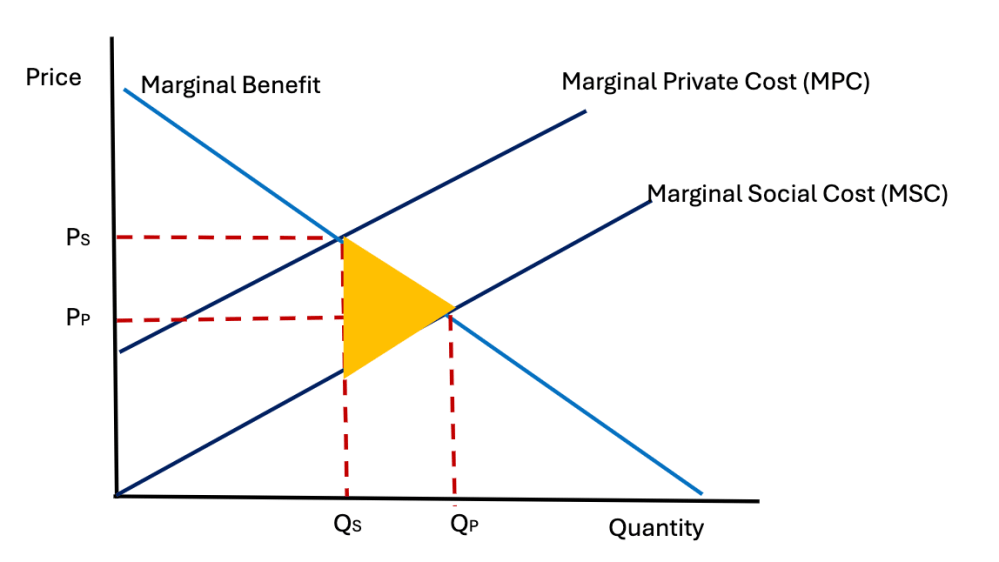
The graph illustrates a market with a positive production externality. We assume the marginal social benefit (MSB) is equal to the marginal private benefit (MPB), which is shown by the Marginal Benefit line.
The Fix
To account for the loss in welfare benefit and overall social welfare, governments use subsidies. By subsidising education, vaccinations, or even public transport, the government lowers the private cost, as well as boosts private benefit, nudging consumers to make choices that align with the social optimum.
Visually, this intervention helps to increase the usage of underutilised goods from Qs to Qp and lowers the price for consumers from PS to Pp.

At their best, these policies help the market internalise external benefits, bridging the gap between private and social value, and ensuring that actions which help everyone do not go under-consumed.
Coase Theorem
While taxes and subsidies are common tools to correct externalities, the Coase Theorem offers an alternative way-out rooted in negotiation, stating that when property rights are clearly defined and transaction costs are low, the affected parties can reach a mutually beneficial agreement on their own – no government intervention needed (whew!). Consider beekeepers and orchard owners. Bees pollinate fruit trees, which helps farmers grow more apples, while also producing honey for the beekeeper. This mutual benefit creates a positive externality. But who pays whom? It depends. In Florida, where orange blossom honey is valuable, beekeepers actually pay farmers for access to their land. In contrast, in Washington, where the honey is less valuable, farmers pay beekeepers to bring hives, because the value lies in crop pollination, not honey. Both parties negotiate based on who benefits more, and the market finds a way to share costs and benefits fairly.
Externalities show where markets fall short – and how tools like taxes, subsidies, or even private negotiation help correct this. The aim is simple: make sure people pay for the damage they cause and are rewarded for the good they do, so that private choices lead to better outcomes for society.
 Crossroads Chronicles
Leave a comment