
A take on Plato’s Cave as a timeless metaphor for how we grow – one illusion at a time.
It is funny how, at the age of twenty, we think what we know encompasses all there is to know about the world and how it works. Everything seems so certain. Then we turn thirty, look back at our twenty-year-old selves and laugh, how foolish and naive to think we knew it all. Once we turn forty, we laugh at our thirty-year-old selves, and the cycle continues. Each stage of life reveals just how little we knew in the one before. And honestly? That’s not wrong. We always believe what we know is it – because at that age, with that level of experience, it’s all we can know.
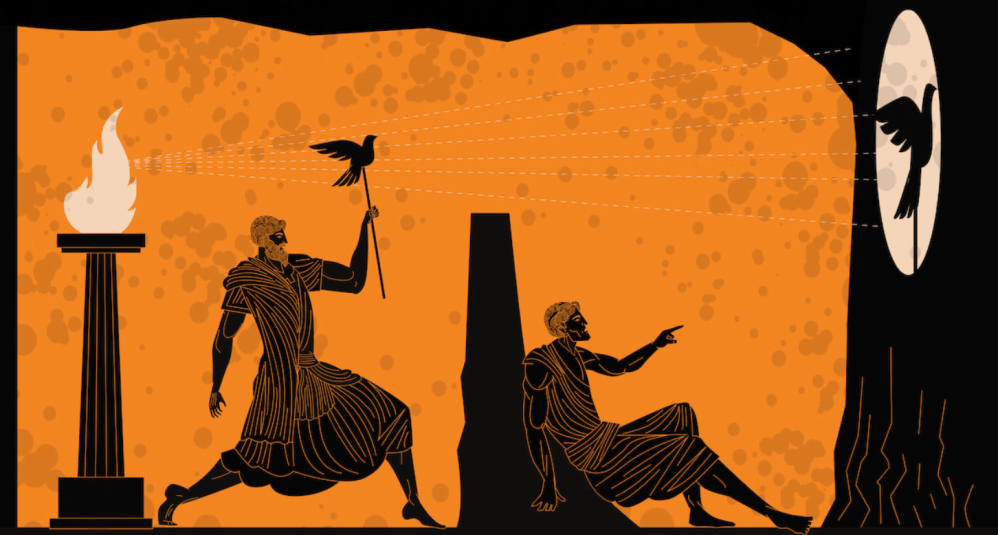
This idea was explained by Plato thousands of years ago, when he presented the Allegory of the Cave to show how our grasp of reality is determined by the restricted information provided by our senses. Imagine a group of prisoners chained to face the back wall of a cave. Their knowledge of reality is the cave wall, they are blissfully unaware of the world outside. Behind them, unseen, a group of people throw shadows of a variety of objects on the walls of the cave, and the prisoners believe that the shadows are the only reality that exist. One day, a prisoner breaks free and steps out into the blinding light. Once he slowly adapts, he sees the sun, trees, animals, and other humans, and his entire faith is blown apart – he realises what he thought he knew was absolutely nothing! He goes back to his fellow prisoners in the cave to share what he now knows, but they laugh him off. They are comfortable in what they know, even if it is an illusion.
The same idea plays out in contemporary adaptations as well. Take, for instance, The Truman Show. The protagonist believes the world he lives in is the actual world – till he starts questioning strange things around him. He eventually finds a literal exit door and finds out that all he lived in was merely a tv show – a constructed reality. Once he steps into the unknown, he turns into Plato’s freed prisoner, leaving behind his world of comfort for the discomfort of reality and the truth.
Interpretations of Plato’s work
Growth and Self-Realisation
A straightforward interpretation of the cave theory can be how growth follows once we step out of our known reality, to explore what all lies beyond. The cave represents our comfort zones; the shadows are our unquestioned assumptions. The journey out is the rather disorienting process of challenging what we believe, and it is through this journey where the actuals growth happens. It is uncomfortable, but it is also liberating.
Resistance to Truth
Another layer of Plato’s allegory of the cave is about how fiercely humans defend their existing beliefs. The prisoners in the cave aren’t just ignorant – they are hostile to anyone who threatens their knowledge. It is a cautionary tale about how people often reject uncomfortable truths and are unwilling to comprehend the limits of their experience, even when they are in plain sight. Because accepting them means tearing down the scaffolding that has held beliefs together so far.

The idea is, no matter how many times we think we’ve seen the light, there may still be more caves, more shadows, more exits ahead. What feels like ultimate truth at thirty might look like a shadow play at forty. And that’s okay. That’s the point.
We’re constantly evolving – shedding old beliefs and old versions of ourselves. The more we grow, the more we realise how much more there is to learn. We’re always on a journey of becoming – of unlearning and stepping into new perspectives. So if you’re ever cringing at your past self, take it as a good sign. It means you have left one cave behind and stepped into a brighter light.
Keep walking toward the light. There’s always more to discover.
 Crossroads Chronicles
Leave a comment