
How Indirect taxes might be the better choice for economic growth compared to Direct taxes
No, this is not a deep dive into Jerry Maguire’s “Show me the money!” moment. This is a dive into where your money goes once it leaves your wallet and lands with the government. The Indian Union Budget for FY26 highlights a notable shift in the tax structure: direct taxes are projected to reach 7.1% of GDP – the highest in recent years – while indirect taxes have remained steady around the 4.9% of GDP mark. So which of the two – direct or indirect taxes – does a better job of fuelling the economy and driving growth? Let’s break it down.
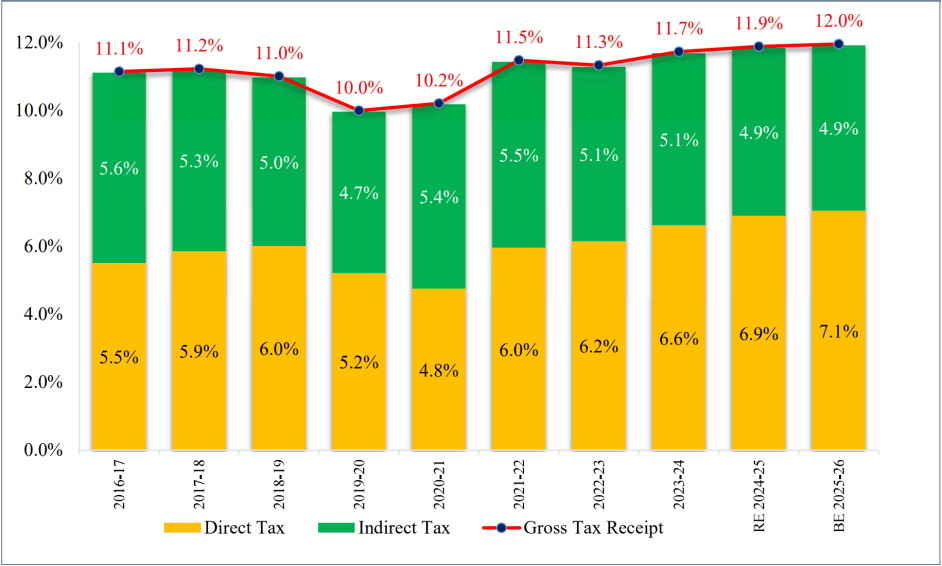
Source: Union Budget Documents 2025 – 2026, Budget at a Glance (https://www.indiabudget.gov.in/)
Understanding Direct and Indirect Taxes
Taxes are the primary source of revenue for any government, helping fund public infrastructure, services, welfare programs and much more. But not all taxes tell the same story.
Direct taxes, such as income tax and corporate tax, are levied directly on individuals and businesses based on their earnings and profits. These taxes are meant to be progressive – If you earn more, you pay more. A growing share of direct taxation in India’s revenue structure suggests an increasing reliance on personal and corporate contributions to public finances. While this approach ensures that those who earn more contribute more, it also raises concerns about economic incentives. High corporate taxes, for instance, can deter business growth, as companies become less eager and more hesitant to reinvest. Additionally, direct taxes primarily impact the formal sector, leaving a significant portion of India’s informal economy outside the tax net.
On the other hand, indirect taxes, such as GST (Goods and Services Tax), excise duties, and customs duties, are applied to goods and services rather than income. You don’t need to be earning a salary to pay these; you just need to buy something. This structure ensures a broader tax base; each economic transaction contributes to government revenue. Moreover, indirect taxes tend to be simpler to collect and enforce, reducing the scope for tax evasion. However, they are often criticised for being regressive, as lower-income groups spend a higher proportion of their earnings on taxable goods and services. This can lead to inflationary pressures, particularly if high indirect taxes drive up consumer prices.
The Case for More Indirect Taxes in Economic Growth

While both direct and indirect taxes play essential roles, a tax system that leans more on indirect taxation can provide a greater stimulus for economic growth. Indirect taxes encourage investment and business expansion by allowing individuals and corporations to retain more of their income. Furthermore, indirect taxes drive consumption and demand, key drivers of economic expansion. When individuals have higher disposable income due to lower direct tax burdens, they tend to spend more on goods and services. This increased demand fuels production, stimulates job creation, and generates higher indirect tax revenues. As a result, the government can still maintain strong fiscal health without overburdening businesses and individuals with high direct taxation.
Another critical advantage of indirect taxation is its ability to broaden the tax base. In India, a significant portion of the population remains outside the direct tax net due to the large informal economy. Indirect taxes, however, capture revenue from every transaction, ensuring that all economic participants contribute to national development. This model strengthens fiscal stability and allows the government to invest in infrastructure, education, and healthcare, which in turn promotes long-term economic prosperity.
Getting that balance right
A well-balanced tax policy should optimize both direct and indirect taxation to ensure sustainable economic growth while maintaining social equity. While India’s tax structure shows an increasing reliance on direct taxes, policymakers must be cautious about the potential downsides of high personal and corporate tax rates. Overburdening businesses with direct taxes could slow down economic activity, while excessive reliance on indirect taxes may disproportionately affect lower-income groups. A progressive approach to indirect taxation, where luxury goods are taxed at higher rates while essential items remain affordable, can help mitigate the regressive nature of consumption taxes.
Ensuring efficient tax collection and reducing tax evasion should be made a priority. Expanding the direct tax net through better compliance and digital integration can reduce the pressure on indirect taxes while maintaining a fair and sustainable revenue model. By striking a careful balance between these two taxation methods, India can create a tax framework that fosters economic growth and brings in employment opportunities.
Conclusion
While both direct and indirect taxes are essential, a tax system that places greater emphasis on indirect taxation while keeping direct taxes moderate can create a more dynamic and investment-friendly environment. By focusing on widening the tax base and ensuring that indirect taxes do not disproportionately impact the lower-income population, India can sustain its growth momentum while maintaining fiscal responsibility. As the country moves forward, a strategic and well-balanced approach to taxation will be key to driving long-term economic success.
 Crossroads Chronicles
Leave a comment