

A system is like a group of things that are connected and work together for a reason. To understand a system, we need to know what elements are in it, how they’re connected, and what function/purpose do they have. A solar system is a system, it has elements (celestial bodies), interconnections (gravitational forces), and a function (maintaining orbits and balance in space). Think of the policy system in these terms, as a giant puzzle, made up of many pieces that fit together to shape the rules and decisions that govern our society. But this puzzle isn’t straightforward; it’s complex, influenced by the past, and often surprises us with unexpected outcomes.
POLICY AS A COMPLEX SYSTEM
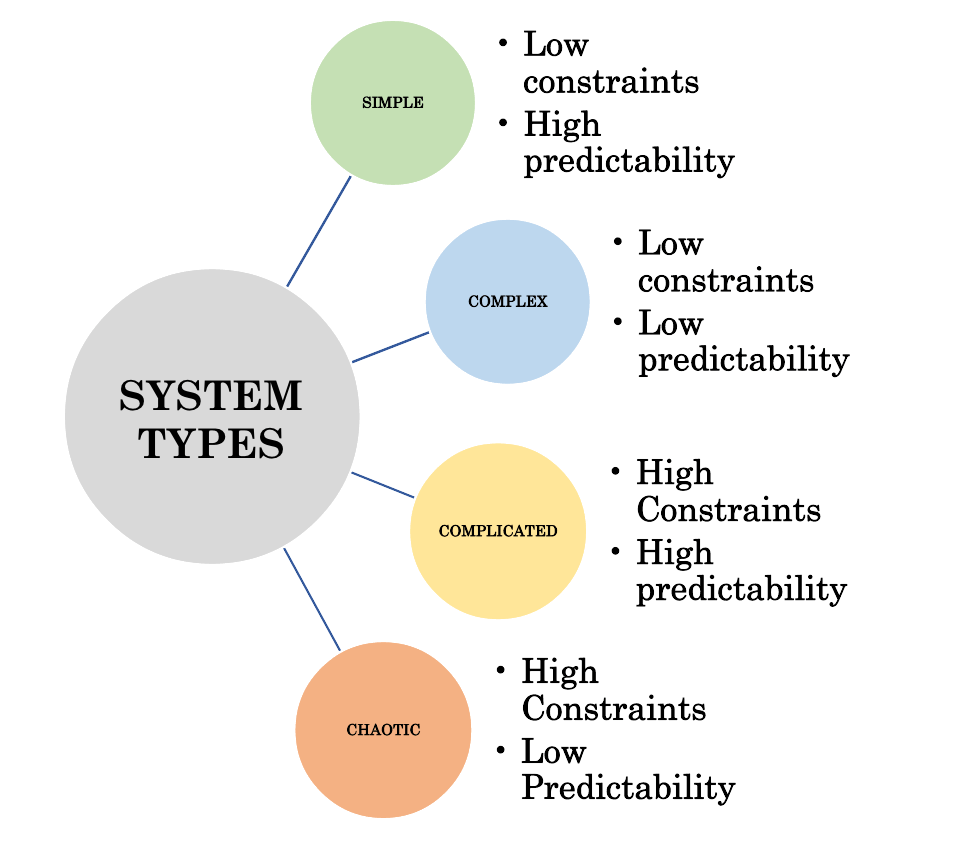
When policy-making involves low predictability and high constraints, it’s like trying to navigate through a maze. You have to make decisions without knowing for sure what the outcomes will turn out to be, and you have to work within limits and challenges to find the best way forward. It requires careful planning, good understanding of the subject area, and creativity to successfully navigate through such complexities.
Complex behaviours of systems often arise as the relative strengths of feedback loops shift, causing first one loop and then another to dominate behaviour.[1]

Imagine there is a toy car that can move forwards or backwards. Now, think of feedback loops like having two children playing with the cars. If the child moving it forward pushes harder, the car moves forward faster. But if the second child pushes harder, the car slows down or even moves backward.
Now, think of this as feedback loops in a system. Sometimes, one loop is stronger than the other, making it influence the behaviour of the system more. The car might speed up, slow down, or change direction depending on which force is stronger at that moment. In complex systems, behaviours can change as these feedback loops become stronger or weaker, and the one which leads can determine how the system behaves.
FEW PROPERTIES OF COMPLEX SYSTEMS
Dynamic and Interconnected – Each step in policy decisions set off a ripple effect, triggering consequences across various sectors. The butterfly effect, often observed in policy-making, highlights how even minor changes can lead to significant outcomes, further amplifying the intricacy of the system.
Path Dependent – This means the path you take is heavily influenced by where you’ve been and the choices you’ve made before. So, when people make policies, each policy sets the stage for the next one. Even small decisions made years ago can have a big impact on what we do now.
Emergent behaviour – In policy-making, where you start and the decisions you make along the way can lead to very different policy outcomes. If policymakers focus on one aspect of a problem, like environmental protection, they might end up with strict regulations on pollution. But if they prioritize economic growth, they might opt for incentives for businesses instead. So, starting from different points can totally change the direction and shape of the policy that’s ultimately put in place.
To conclude, understanding policy means seeing the big picture, recognising how past decisions influence the present, and being prepared for unexpected turns. By doing this, we can make better decisions that benefit everyone in society. We’ll talk about policy analysis in a subsequent blog to breakdown the process even further. For now, we’ve reached the end, thank you for sticking around!
The insights presented above draw from the teachings of Donella H. Meadows’ book “Thinking in Systems” [1] and the blog available at https://fs.blog/mental-models/#systems.
 Crossroads Chronicles
Leave a comment