
India’s patent grant rate in 2022 stood at a modest 27 patents per million population, significantly lower compared to other emerging economies. This indicates a bottleneck in the process of patent acquisition, which is crucial for protecting intellectual property and fostering innovation.
Why is low patent a problem?
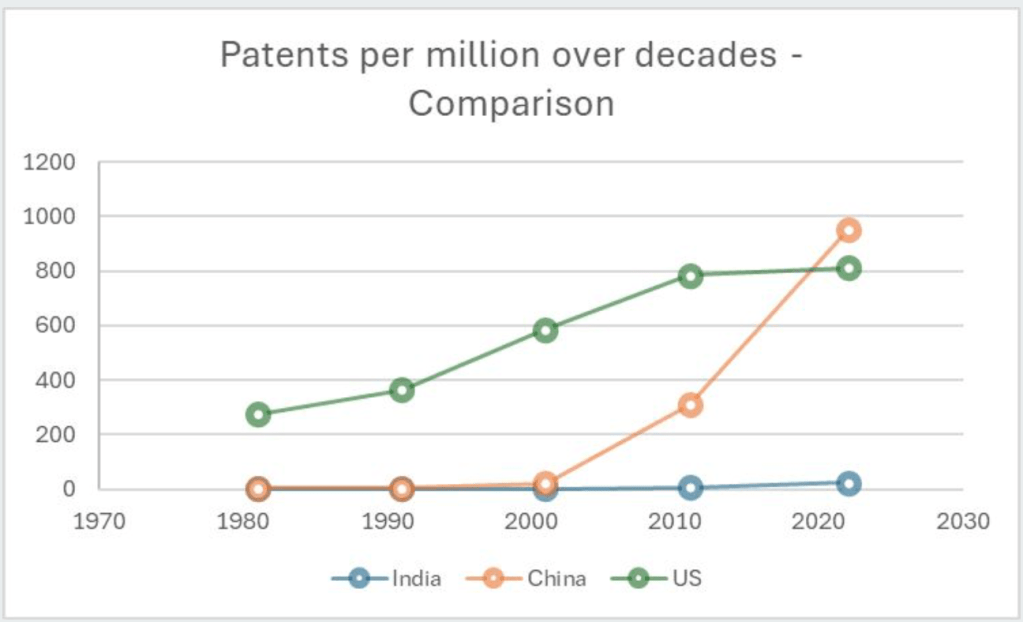
Patents are an important innovation output that serve as an indicator of competitive intelligence and give a boost to the economy.
- The number of patents applied and granted in India are far lesser than China, USA and several other countries.
- Challenges within the current patent landscape include low R&D investment, inefficiencies in patent filing processes, low IPR awareness, and reluctance among foreign players to engage due to pending grievance issues.
The Proposed Solution
While our team involved in the policy simulation exercise solution delved into a three-pronged approach to address the problem – Systemic improvement, enabling investments in research, and creating impetus for research in education systems, for this article, I will be describing the education system proposal, with subsequent blogs covering the remaining two approaches, alongwith the overall roadmap discussion.
Stakeholders – Ministry of Education, Ministry of Science & Technology, State Governments, Local Governments, Private companies, startups, and Central, State, Private Universities
IP Units in Universities:
- Data indicates that establishing IP units and technology transfer centres in universities can significantly enhance patent awareness and filing processes.
- Set up of ~1-2 ‘IP units’ & Technology Transfer Centres in 48 Central, 399 State and select Private Universities to create awareness and aid with patent filing.
- Estimated Cost for stakeholders involved ~2k cr
Industry – University Linkages:
- Establish new Research linkages with private companies to fuel University-Industry partnerships
- Cooperative committees dedicated to university-industry cooperation can drive market competition and enhance employment prospects for research students.
- Estimated Cost for stakeholders involved ~4k cr
School and University Tie-up at Division level
- Hiring additional personnel across schools, universities, and research units will bolster expertise and capacity.
- Allocating funds to schools and universities ensures they have the resources necessary for technical training.
- Technical training is essential for preparing students for the demands of the modern workforce.
- Estimated cost for stakeholders involved ~5k cr
Projection Estimate
Estimated Impact 30% annual increase in number of patents filed in focussed sectors
Incentives & Unintended Consequences
Incentives such as economic growth, international recognition, collaboration, human capital development, capacity building, better job prospects and stipends for students, along with financial support for research and tax incentives for R&D centres, offer compelling reasons for stakeholders to engage.
However, it’s essential to remain vigilant regarding potential pitfalls. Misuse of funds and concerns about the quality of research equipment must be addressed proactively to ensure the effectiveness and integrity of our innovation initiatives.
Thank you for being here! Stay tuned for more articles on the remaining proposals and solutions, and to get a further breakdown of the cost estimation included.
 Crossroads Chronicles
Leave a comment